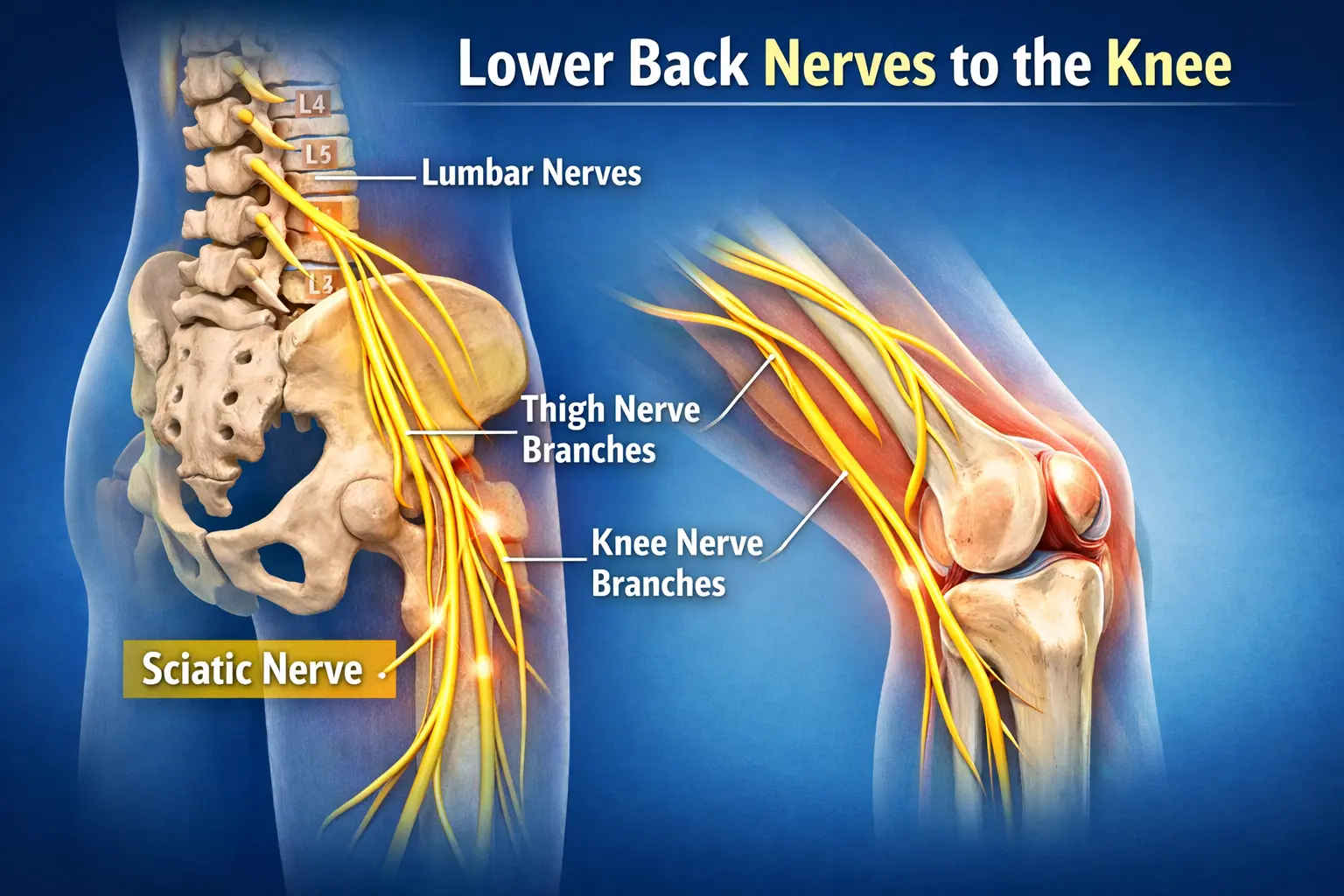
When you feel pain in your knee, it seems obvious where the problem is.
It must be the knee… right?
Not always.
At Northwood Chiropractic Oxford, we regularly see knee pain that is being driven, influenced or prolonged by dysfunction in the lower back.
Let’s explain why.
The Lower Back and Knee Are Connected
Your lower back, also known as the lumbar spine, is where the nerves that supply your hips, thighs, knees and feet originate.
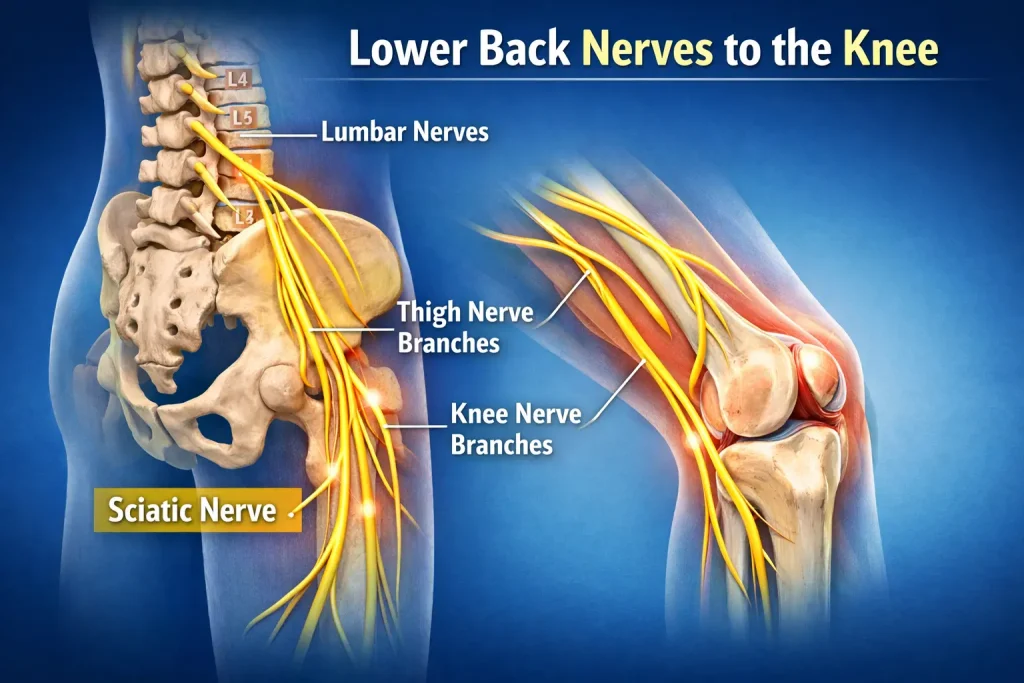
These nerves:
- Control muscle strength
- Coordinate movement
- Provide sensation
- Help stabilise your joints
If joints in the lower back are not moving properly, this can affect how those nerves function. Even subtle mechanical stress can alter how well signals travel from your brain to your leg.
That means the muscles supporting your knee may not be firing as efficiently as they should.
Over time, that can lead to overload, irritation and pain around the knee joint.
What About Meniscus Tears or Arthritis?
Meniscus tears, ligament strains and knee osteoarthritis are very real conditions. They often show up clearly on scans.
But here is the key question:
Why did it develop, and why is it not improving?
If the nerve supply from the lower back is compromised, it can:
- Reduce muscle stability around the knee
- Change walking mechanics
- Increase strain on cartilage and ligaments
- Slow down healing
For example, if the quadriceps or glute muscles are not activating properly because of lumbar dysfunction, extra stress can be transferred directly into the knee joint.
We also see patients whose knee pain has lasted months or years despite injections, exercises or braces. When we assess them, we often find significant restriction or imbalance in the lower back and pelvis that has never been addressed.
The knee may be injured, but the reason it is not recovering could be higher up the chain.
The Body Works as a Chain
Your body does not work in isolated parts. It works as a connected system.
Lower back connects to pelvis.
Pelvis connects to hip.
Hip connects to knee.
Knee connects to ankle and foot.
If one link is not functioning well, the others compensate.
At Northwood Chiropractic Oxford, we do not just look at the knee. We assess:
- The lumbar spine
- The pelvis and hip mechanics
- The knee joint itself
- The ankle and foot
- Muscle balance and movement patterns
- Neurological function
We are always asking:
What is the root cause of this knee not recovering?
Sometimes the knee is the main issue.
Sometimes the lower back is driving the problem.
Often, it is a combination of both.
Why This Matters
If you only treat the painful knee without addressing the underlying cause, the problem can keep returning.
It is like changing a worn tyre without fixing the wheel alignment.
By restoring proper movement in the lower back and pelvis, and improving nerve function, we can often:
- Improve knee stability
- Reduce joint overload
- Support better healing
- Help prevent recurrence
Could Your Lower Back Be Involved?
If you have:
- Knee pain that will not settle
- Pain that travels into the thigh or shin
- A history of lower back pain
- Recurrent knee flare ups
- Treatment that only gives short term relief
It may be time to look beyond the knee.
Your knee pain could be coming from your lower back.
If you are struggling with ongoing knee problems, we would be happy to assess the whole mechanical and neurological chain and help you understand what is really going on.
