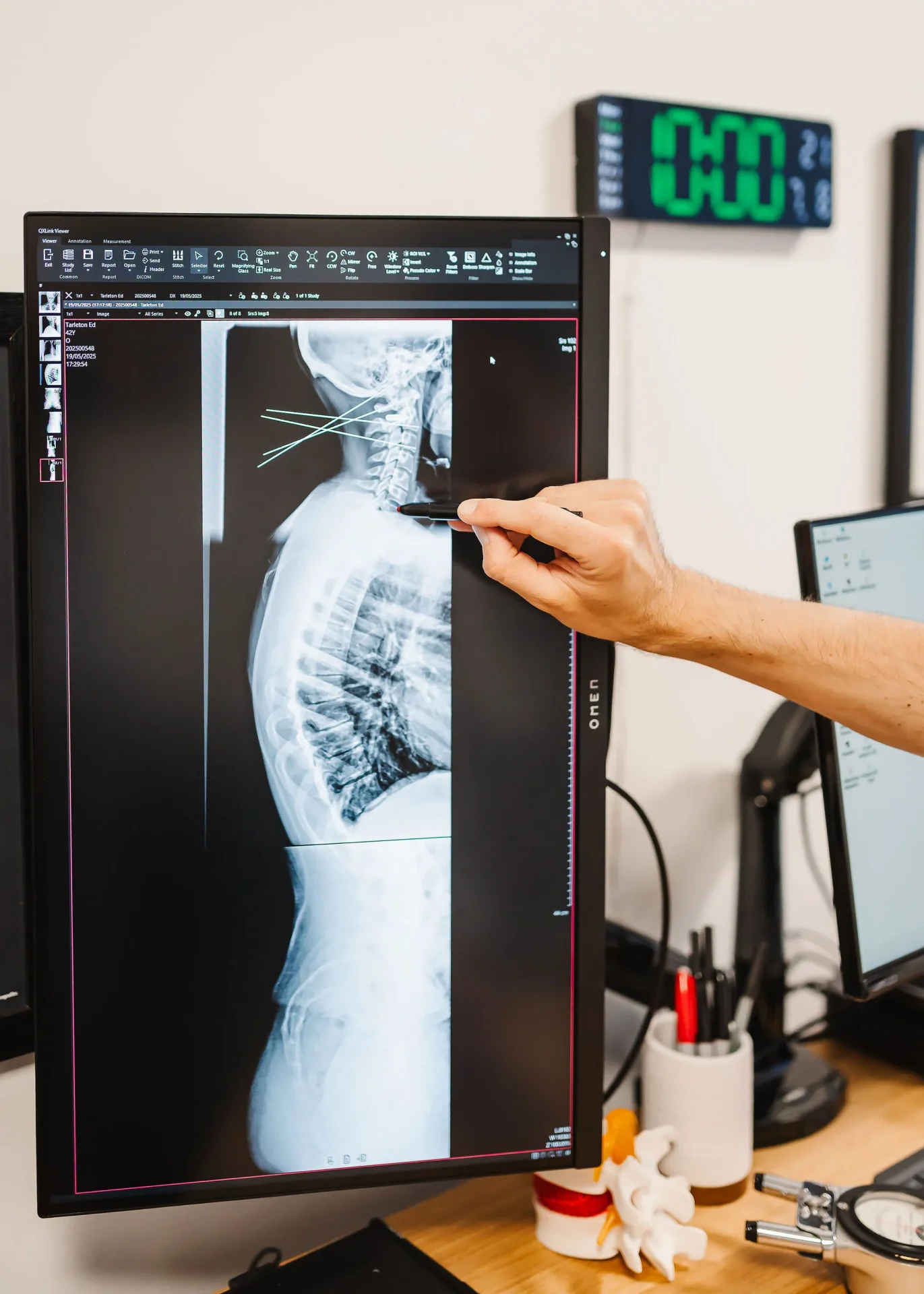
If you have been advised that X-rays are needed as part of your Chiropractic assessment, you might be wondering why. You came in with back pain or a stiff neck — surely a hands-on examination is enough?
In many areas of healthcare, that might be true. But in Gonstead Chiropractic, where the goal is to deliver a precise, specific correction to an exact spinal level, X-rays are not a formality. They are one of the most important tools we have — and the information they provide directly influences the quality of your results.
Here is why.
We Need to See What We Are Adjusting
Imagine asking a surgeon to operate without being able to see inside the body. They might have a good idea of what is there based on the patient's symptoms and their clinical examination — but would you want them to proceed without imaging? Almost certainly not.
The same principle applies in Chiropractic. The spine is a complex, three-dimensional structure, and no two spines are the same. What we find on the surface through examination — through structure analysis, instrumentation, and palpation — gives us a strong indication of where the problem is and what is happening. But it cannot tell us everything.
X-rays allow us to see the spine directly. The exact position of each vertebra. The condition of the discs. The angles, the curves, the subtle shifts that are invisible to even the most experienced hands from the outside.
Adjusting without that information would be like a locksmith trying to cut a key without ever seeing the lock. You might get close. But close is not good enough when precision is the entire point.
Confirming What the Examination Found
The Gonstead examination is thorough and objective — but X-rays add a critical layer of certainty. When the clinical findings and the X-ray findings align, we know we are looking in the right place. That confirmation matters.
In cases where the examination points toward one area but the X-ray reveals something slightly different — a structural variation, an unexpected finding, a level of involvement we did not anticipate — we would rather know before the adjustment than after. X-rays catch what hands alone cannot, and that protects you.
This is not about doubting the examination. It is about doing everything in our power to be right.

Defining the Exact Position of the Problem
Knowing that a vertebra is not where it should be is only part of the picture. Knowing precisely how it has shifted — the direction, the angle, the degree of displacement — is what allows us to correct it accurately.
In Gonstead Chiropractic, every Adjustment has a specific vector. A direction of force, applied at a specific angle, to move a specific joint back toward its correct position. Without X-rays, we are estimating that vector. With them, we are measuring it.
This is the difference between an adjustment that is approximately right and one that is exactly right. Over a course of care, that difference accumulates. Specific corrections produce specific results. Approximate corrections produce approximate results.
Seeing the Structure of the Spine
X-rays allow us to assess the overall architecture of your spine in a way that no other examination tool can. This includes identifying:
Scoliosis — lateral curvatures of the spine that may be contributing to your symptoms and need to be factored into how we approach your care.
Abnormal spinal curves — the cervical spine should curve forward, the thoracic spine backward, and the lumbar spine forward again. When these curves are lost, reversed, or exaggerated, it tells us something important about the long-term health of the spine and the nervous system.
Structural variations — anatomical differences unique to your spine that affect how we approach each adjustment. No two spines are alike, and what is correct for one patient may be entirely wrong for another.
Without this structural overview, we would be working from a partial picture. With it, we can tailor care specifically to the spine in front of us.
Assessing the Level of Degeneration
One of the most valuable — and often most revealing — things X-rays show us is the degree of degenerative change in the spine. And this tells us something that symptoms alone never could: how long the underlying problem has really been there.
Degeneration does not happen overnight. Changes to disc height, the formation of bone spurs, and alterations in joint surfaces develop slowly over months and years. When we see these changes on X-ray, we know that the problem predates your symptoms — often by a significant margin.
This is why two patients can describe what sounds like the same complaint but have very different clinical pictures. One may have a recent issue with no structural change. The other may have a spine that has been under stress for years, with the recent pain simply being the point at which it finally broke through into symptoms.
Understanding the degree of degeneration helps us set realistic expectations, plan the appropriate length of care, and explain to you honestly what is going on — not just now, but in the context of your spine's history.
Better Information Means Better Results
All of this comes down to one thing: the more accurately we can define the problem, the better we can address it.
X-rays do not replace the clinical examination. They complete it. Together, the examination and the imaging give us a level of certainty and specificity that neither could provide alone. And that certainty translates directly into the quality of your care.
Patients whose care is guided by X-ray analysis receive more specific adjustments, targeted more accurately, from the very first session. Over time, this produces better results — and results that hold for longer, because the corrections are being made to the right place, in the right direction, at the right level.
This is why we take X-rays when they are indicated. Not as a routine procedure, not to cover ourselves, but because they genuinely help us help you more effectively.
Are X-Rays Safe?
Yes. Modern digital X-rays use a fraction of the radiation of older film-based systems, and the dose involved in a spinal X-ray series is low — comparable to a few hours of natural background radiation from the environment we all live in every day.
X-rays are only taken when clinically indicated. We do not take them as a default for every patient, and we do not take views that are not necessary for the analysis. The decision is always based on whether the information they will provide justifies the minimal dose involved — and in the cases where we recommend them, it does.
If you have any concerns about radiation exposure, please ask. We are always happy to explain our reasoning.
Frequently Asked Questions
Does every Chiropractic patient need X-rays? No. X-rays are taken when clinically indicated — based on your case history, your examination findings, and what we need to know in order to care for you safely and specifically. Not every patient requires them.
Where are X-rays taken? X-rays are arranged externally and carry a separate cost. Dr. Hulme will advise you at the end of your first visit if X-rays are required and explain the process clearly.
Will I see my X-rays? Yes. Your X-rays are reviewed with you as part of your report at your second visit. We go through what we found and what it means in plain language.
What type of X-rays are taken? Where indicated, full-spine standing X-rays are taken in a weight-bearing position. This is important because it shows the spine as it functions under load — not lying down, which can give a misleading picture.
Can I have Chiropractic care without X-rays? In some cases, yes. If X-rays are clinically indicated and you decline them, we will discuss what that means for the specificity of your care honestly and transparently. Our priority is always your safety and the quality of your results.
The Bottom Line
X-rays are not about ticking boxes or adding cost to your care. They are about making sure that every adjustment we deliver is as accurate, as safe, and as effective as it can possibly be.
If we recommend X-rays as part of your assessment, it is because we believe they will make a meaningful difference to your results. And in Gonstead Chiropractic, that belief is backed by decades of clinical evidence.
Ready to find out what is really going on with your spine? Book your initial consultation at Northwood Chiropractic Oxford today.
👉 northwoodchiropracticoxford.co.uk/book-online
Published: 8th July 2026 Author: Dr Steven Hulme, Chiropractor — Northwood Chiropractic Oxford
