
Shoulder pain is one of those complaints that people tend to manage for longer than they should. It gets dismissed as a muscle strain, attributed to sleeping awkwardly, or simply accepted as something that comes with desk work or sport. And for a while, that approach seems to work. The shoulder eases up, life continues, and the problem is filed away as resolved.
Until it comes back. Or never quite goes away in the first place.
If your shoulder has been troubling you for weeks, months, or longer, and rest, stretching, or physiotherapy have not produced lasting relief, it is worth understanding why. Because shoulder pain that does not resolve is rarely just a shoulder problem.
Why the Shoulder and Spine Are More Connected Than You Think
The shoulder is one of the most mobile joints in the body. That mobility is what makes it so useful, but it also makes it dependent on a stable, well-functioning foundation. The nerves that supply the muscles, tendons, and tissues of the shoulder originate in the cervical spine, the lower neck. The muscles that control shoulder movement attach to the thoracic spine and scapula. And the biomechanics of how the shoulder moves are directly influenced by the position and motion of the spine beneath it.
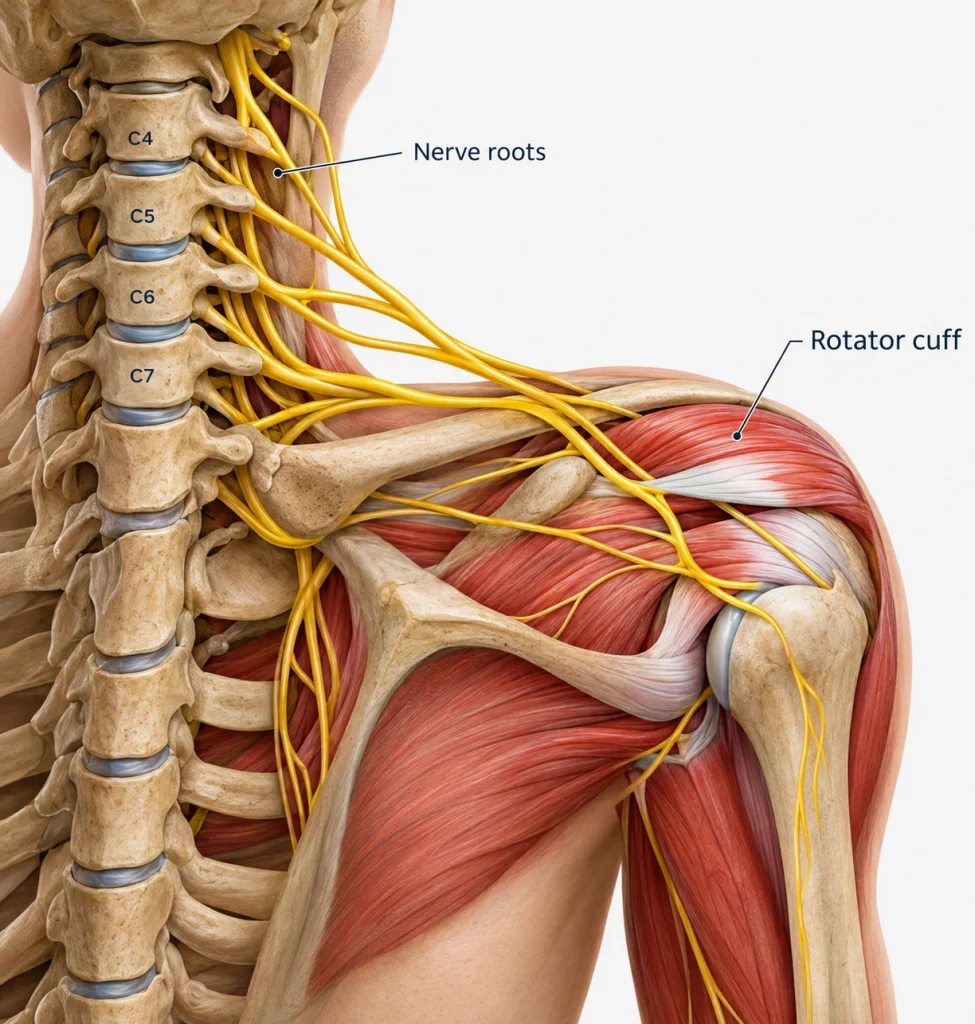
When the cervical or upper thoracic spine has restricted or misaligned joints, the consequences do not stay local. The nerves exiting those levels supply the shoulder, upper arm, and surrounding musculature. When they are being mechanically irritated, the muscles they control do not function as they should. Some tighten. Others weaken. The result is a shoulder that is being asked to work within a neurological and mechanical environment that is not functioning correctly.
Treating the shoulder in isolation, without considering what is happening in the spine that supplies it, is often why shoulder problems fail to resolve fully.
What Types of Shoulder Pain Can Chiropractic Help With?
Chiropractic care is not appropriate for every shoulder presentation. A proper assessment is always required to understand what is driving the problem. But there are several common shoulder complaints where addressing the spinal component makes a significant difference.
Neck-related shoulder pain. Pain that runs from the neck into the shoulder, or that feels worse when the neck is moved in certain directions, often has a clear cervical spine origin. Nerve irritation at the relevant spinal level produces referred symptoms into the shoulder and arm that will not resolve until the source is addressed.
Rotator cuff problems. The rotator cuff muscles are supplied by nerves that exit the lower cervical spine. Chronic rotator cuff issues, particularly those that have not responded well to physiotherapy, sometimes have an underlying spinal component that has not been identified. When the nerves supplying these muscles are compromised, the muscles themselves cannot function optimally regardless of how much rehabilitation work is done.

Frozen shoulder. Adhesive capsulitis, the progressive stiffening and pain of the shoulder joint, is not fully understood, but there is a significant neurological component to its development and progression. Chiropractic assessment of the cervical and upper thoracic spine frequently reveals restrictions at the levels that supply the shoulder, and addressing those restrictions alongside appropriate shoulder care can improve outcomes.
Upper back and shoulder blade pain. Pain around the shoulder blade and upper back is very commonly driven by thoracic spine restriction rather than the shoulder itself. The thoracic spine is often the most overlooked contributor to what feels like a shoulder problem.
The Cervical Spine: The Most Overlooked Cause of Shoulder Pain
Of all the spinal contributors to shoulder pain, the cervical spine is the most frequently missed.
The nerves that exit between the fifth and seventh cervical vertebrae supply the deltoid, biceps, triceps, and rotator cuff muscles. When any of these levels are restricted or misaligned, the consequences can include pain, weakness, altered muscle tone, and impaired shoulder mechanics. The shoulder may feel like the problem. The spine is where the problem originates.
This is not a rare or unusual clinical presentation. It is extremely common, particularly in people with a history of desk work, poor posture, previous neck injury, or progressive forward head posture. Many of the patients who come to us with shoulder complaints that have not resolved elsewhere have, on examination, clear cervical or thoracic restriction at the levels supplying the shoulder.
Once those restrictions are addressed and the relevant nerve pathways are no longer being mechanically irritated, the shoulder often begins to respond in ways it could not before.
What the Gonstead Assessment Looks For
At Northwood Chiropractic Oxford, a shoulder complaint is never assessed in isolation. The Gonstead five-criteria examination evaluates the entire spine, with particular attention to the levels most likely to be contributing to the shoulder presentation.
Postural analysis shows us how the head, neck, and shoulders are positioned relative to one another. Instrumentation identifies temperature differentials along the spine that indicate nerve irritation at specific levels. Palpation assesses joint restriction in the cervical and thoracic spine. Standing X-rays, where indicated, give us a precise picture of spinal alignment and the exact vertebral levels involved.
This level of detail means we are not guessing which part of the spine is contributing. We know, specifically, what is involved and what is needed to address it. That specificity is what makes the approach effective.
When Should You Consider Seeing a Chiropractor for Shoulder Pain?
A Chiropractic assessment is worth considering in the following situations.
Your shoulder pain has been present for more than a few weeks without a clear improvement. The pain travels from your neck into your shoulder, or from your shoulder down your arm. Your shoulder pain is accompanied by neck stiffness or headaches. You have had physiotherapy or massage but the problem keeps returning. Your shoulder feels weaker than it should, or certain movements are consistently restricted.
Any of these patterns suggest that the spine may be contributing to what feels like a purely shoulder problem. The assessment will tell us whether that is the case, and if so, what is needed to address it.
When Chiropractic May Not Be the Right Starting Point
Chiropractic care is not appropriate for all shoulder presentations, and it is important to be honest about this.
At Northwood Chiropractic Oxford, if we find on assessment that Chiropractic is not the right starting point for your presentation, we will tell you clearly and direct you to the most appropriate form of care. The assessment is never wasted. Understanding what is driving the problem is always the right first step.
Frequently Asked Questions
How quickly will my shoulder respond to Chiropractic care? This depends on how long the problem has been present, the degree of spinal involvement, and how established any soft tissue changes are. Some patients notice improvement within the first few sessions. Others with longer-standing problems take more time. The assessment gives us a much clearer picture of what is realistic in your specific case.
Can Chiropractic help if I have already had shoulder surgery? It depends on what the surgery involved and how long ago it was. In many cases, Chiropractic care of the cervical and thoracic spine can support recovery and function following shoulder surgery without involving the surgical site. We discuss this in detail during the assessment.
Will the adjustment hurt? Most patients find the adjustment comfortable. Some experience mild soreness in the adjusted area in the day or two following a session, which is normal and typically short-lived.
Do I need a GP referral? No. You can book directly with us without seeing your GP first.
What if my shoulder pain is also causing arm pain or tingling? Symptoms travelling from the shoulder into the arm, particularly tingling or numbness, are a strong indicator of nerve involvement from the cervical spine. This is something a Gonstead assessment is specifically designed to identify and address.
The Bottom Line
Shoulder pain that does not resolve is often not just a shoulder problem. The spine supplies the shoulder, controls the muscles around it, and directly influences its mechanics. When the relevant spinal levels are not functioning correctly, the shoulder cannot function optimally, regardless of how much local treatment it receives.
A thorough Chiropractic assessment will tell you whether the spine is contributing to your shoulder problem and, if so, what is needed to address it properly.
Book your initial consultation at Northwood Chiropractic Oxford today.
👉 northwoodchiropracticoxford.co.uk/book-online
Published: 23rd September 2026 Author: Dr Steven Hulme, Chiropractor, Northwood Chiropractic Oxford
