
Migraines are one of the most debilitating conditions a person can experience, and one of the most commonly mismanaged. The standard approach — pain relief, rest in a dark room, waiting for it to pass — addresses the symptom but never the question of why it keeps happening. For many people, that question has a spinal answer.
Chiropractic care is not a cure for migraines, and it is important to be honest about that. But for a significant proportion of migraine sufferers, the cervical spine is a contributing factor that has never been properly assessed or addressed. When it is, the frequency, duration, and severity of migraines often improve considerably.
What Is Actually Happening During a Migraine?
A migraine is not simply a bad headache. It is a complex neurological event involving changes in brain activity, blood flow, and pain signalling. The exact mechanisms are not fully understood, but what is clear is that the trigeminal nerve, the main sensory nerve of the head and face, plays a central role. When this nerve becomes sensitised or overactivated, it triggers the cascade of symptoms most migraine sufferers know well: throbbing head pain, often one-sided, nausea, sensitivity to light and sound, and in some cases an aura of visual or sensory disturbances before the headache begins.
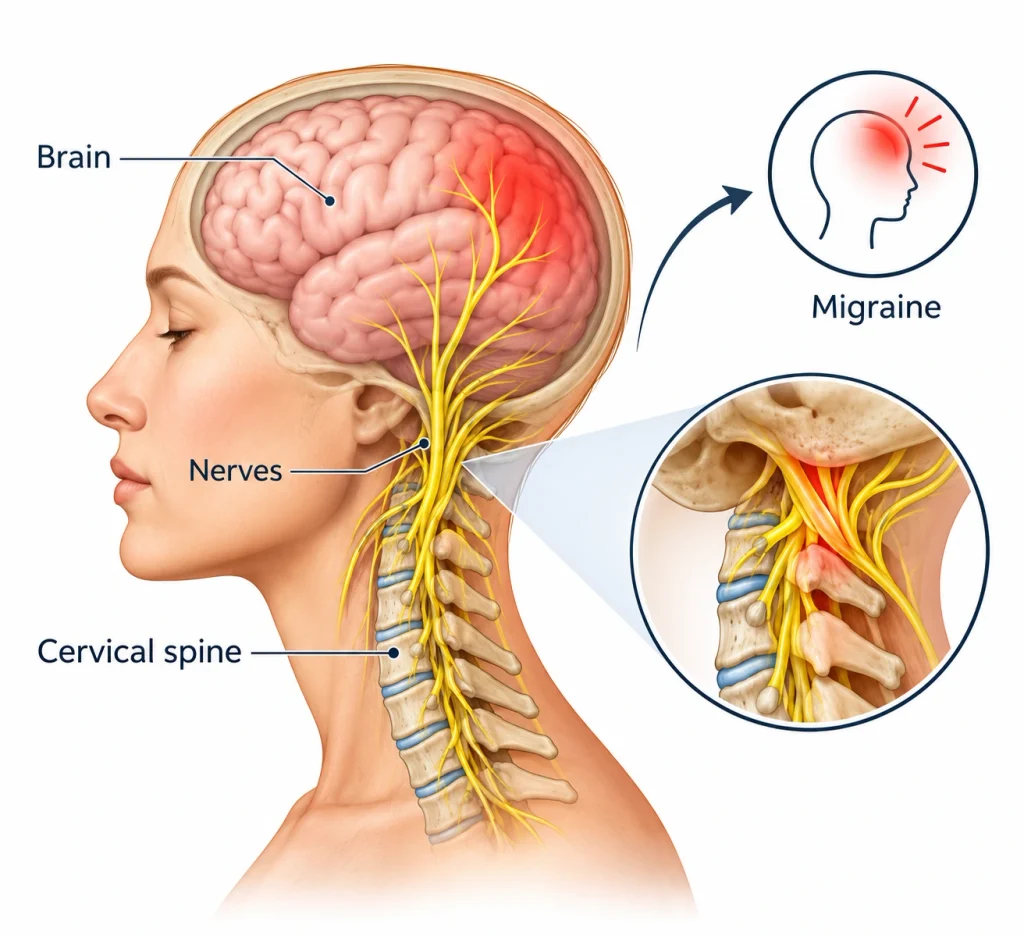
What is also clear is that the upper cervical spine, the top two or three vertebrae of the neck, shares a direct neurological relationship with the trigeminal nerve through a region of the brainstem called the trigeminocervical nucleus. This is the anatomical basis for the connection between cervical spine dysfunction and migraine. Irritation or restriction at these upper cervical levels can feed directly into the same pain pathway that drives a migraine attack.
The Cervical Spine as a Migraine Trigger
Many migraine sufferers notice a pattern: neck stiffness or tension in the hours before an attack, migraines that begin at the base of the skull, pain that starts in the neck and moves forward, or attacks that seem to be triggered by particular head positions or sustained postures. These are not coincidences. They are signs that the cervical spine is involved in the migraine process.
When vertebrae in the upper cervical spine are restricted or misaligned, they create ongoing irritation to the nerves and structures that share anatomical territory with the trigeminal pathway. This persistent low-level irritation can lower the threshold at which a migraine is triggered, making the nervous system more reactive and attacks more frequent.
This does not mean every migraine has a purely cervical cause. Migraines are multifactorial, and triggers vary between individuals. But the cervical spine is a contributing factor that is systematically overlooked in conventional migraine management, partly because few healthcare providers routinely assess it with the detail required to identify specific levels of dysfunction.
How the Gonstead Assessment Approaches Migraines
At Northwood Chiropractic Oxford, a patient presenting with migraines receives a thorough Gonstead assessment before any care is undertaken. This involves a detailed case history to understand the pattern, frequency, and character of the migraines, alongside instrumentation to detect areas of nerve irritation in the cervical spine, static and motion palpation to identify restricted or misaligned vertebrae at specific levels, and postural analysis to assess the alignment of the cervical and upper thoracic spine as a whole.
Where indicated, standing X-rays of the cervical spine give a precise picture of vertebral alignment and any structural changes that may be relevant. This level of detail is what the Gonstead method is built around: identifying the specific vertebral level that needs to be addressed, rather than adjusting broadly and hoping for improvement.
If the assessment identifies cervical dysfunction that is likely contributing to the migraine pattern, care is directed precisely at those levels. If the assessment does not find a cervical component that chiropractic can reasonably address, we will tell you honestly and help you identify the most appropriate next step.
What the Evidence Suggests
The research on chiropractic care and migraines is genuinely encouraging, even if it remains an evolving area. Multiple clinical trials have found that spinal adjustments can reduce migraine frequency and intensity in people where cervical involvement is present. A 2018 randomised controlled trial published in the European Journal of Neurology found that spinal manipulation was as effective as topiramate, a commonly prescribed migraine preventive medication, in reducing migraine frequency over a six-month period. Studies consistently show that patients who respond well are those with a clear cervical component to their migraines, which is why a thorough assessment before beginning care matters so much.
Chiropractic is not appropriate for every migraine presentation, and it works best as part of an overall approach that may include identifying dietary and lifestyle triggers, sleep management, and in some cases medication. But for those whose migraines have a cervical component that has never been properly addressed, it can make a substantial difference to quality of life.
Cervicogenic Headache Versus Migraine
It is worth distinguishing between true migraines and cervicogenic headaches, because they are separate conditions that can appear similar and often coexist.
A cervicogenic headache originates directly from a structural problem in the cervical spine. The pain typically begins at the base of the skull or back of the neck and radiates forward, is provoked by neck movement or sustained postures, and is usually one-sided and non-throbbing. It does not typically produce nausea or light sensitivity in the way a migraine does, although there can be overlap.
Cervicogenic headaches respond very well to chiropractic care, because they are directly caused by cervical dysfunction. Migraines with a cervical component sit somewhere in between: the migraine mechanism is neurological and more complex, but the cervical spine is feeding into it. Both can be present simultaneously in the same person, which is not uncommon. The assessment determines which is driving the symptoms and what care is most appropriate.
Frequently Asked Questions
How many sessions before I notice a difference?
This varies depending on how long the migraines have been present, the degree of cervical dysfunction found on assessment, and individual response. Some patients notice a reduction in frequency within the first few weeks of care. Others take longer. The assessment gives a much clearer picture of what to expect in your specific case.
Can chiropractic help with migraines that have no obvious neck component?
If the assessment does not identify cervical dysfunction that is likely contributing to your migraines, we will be honest with you about that rather than proceeding with care that is unlikely to help. Chiropractic is not the right answer for every migraine presentation.
Should I stop my migraine medication if I start chiropractic care?
No, and we would never advise that. Any decisions about medication are between you and your GP or neurologist. Chiropractic care can work alongside medication as part of an overall approach to managing migraines more effectively.
Do I need a referral from my GP?
No. You can book directly with us without seeing your GP first.
The Bottom Line
Migraines are complex, and there is rarely a single cause or a single solution. But the cervical spine is a consistently overlooked contributing factor for a significant proportion of sufferers, and addressing it properly can make a real difference to how often migraines occur and how severely they affect daily life.
If your migraines involve neck tension or stiffness, begin at the base of the skull, or follow patterns that suggest a postural or positional component, a thorough cervical assessment is a logical and worthwhile step.
Book your initial consultation at Northwood Chiropractic Oxford today.
northwoodchiropracticoxford.co.uk/book-online
Published: 21st October 2026
Author: Dr Steven Hulme, Chiropractor, Northwood Chiropractic Oxford
