
Hip pain is one of the most common presentations we see at Northwood Chiropractic Oxford. It is also one of the most misunderstood. People tend to assume the problem is in the hip, rest it, stretch it, and when that does not work, they begin to worry about arthritis or surgery. But in a significant proportion of cases, the hip is not where the problem originates at all.
Understanding where hip pain actually comes from, and what can be done about it, often requires looking somewhere quite different.
Hip Pain Is Often Not a Hip Problem
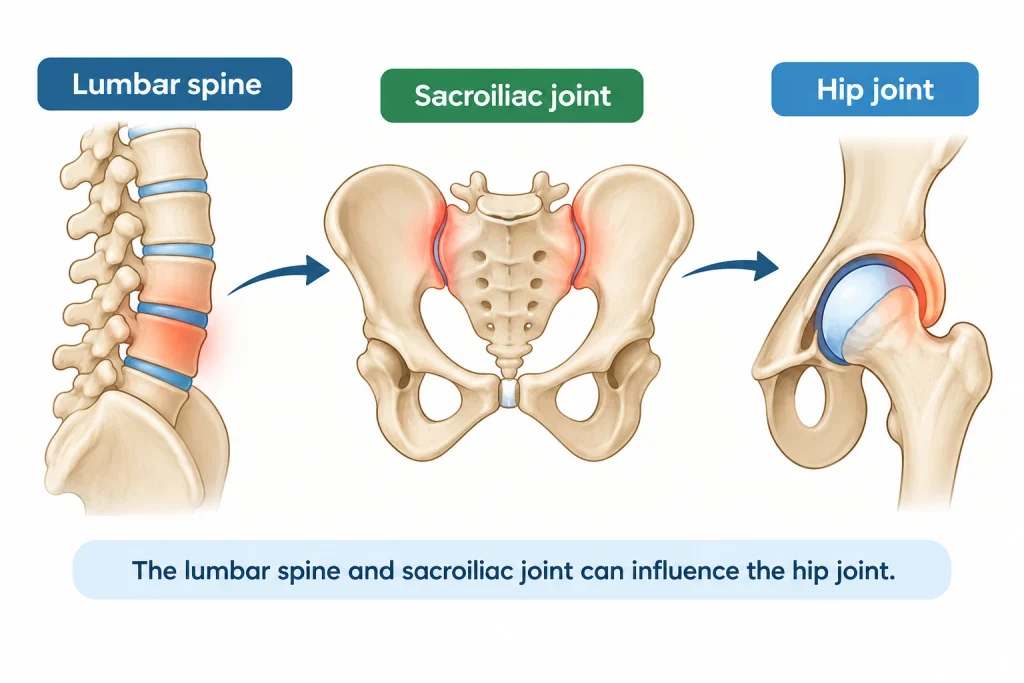
The lumbar spine and sacroiliac joints share nerve supply, movement patterns, and mechanical load with the hip. When the spine or pelvis is not functioning correctly, the consequences very often show up as pain in and around the hip joint, sometimes without any structural problem in the hip itself.
The nerves that exit the lower lumbar spine travel directly into the hip region, the buttock, the groin, and the upper leg. When these levels are restricted or misaligned, the referred pain they produce can feel exactly like a hip problem. It can be localised, achy, and worse with movement, and it can persist for months or years while the actual cause in the spine goes unidentified.
This is not a rare or unusual clinical picture. It is extremely common. Many patients who arrive at the clinic with a longstanding hip complaint have, on assessment, clear spinal or pelvic restriction at the levels driving their symptoms, rather than a primary hip pathology at all. Once those restrictions are addressed, the hip pain resolves, because it was a spine problem presenting as a hip problem all along.
A thorough assessment is the only way to distinguish between the two. Treating the hip when the source is the spine will not produce lasting results.
What About Hip Arthritis?
Hip osteoarthritis is a genuine and common condition, and it is worth being straightforward about what chiropractic can and cannot do for it.
Arthritis itself, the degenerative change within the joint, cannot be reversed. That is the honest answer, and any practitioner who suggests otherwise is not being truthful with you. However, arthritis in isolation is rarely the whole story, and this is where chiropractic has a meaningful role to play.
Arthritis develops and progresses when a joint is subjected to abnormal or uneven mechanical load over time. The rate at which a joint deteriorates is not random. It is directly influenced by how well the surrounding structures are functioning. When the spine and pelvis are aligned and moving correctly, load is distributed evenly across the hip joint. When they are not, certain areas of the joint are subjected to disproportionate stress, and degeneration accelerates accordingly.
This means that while chiropractic cannot address the arthritis directly, it can address the mechanical environment that is contributing to it. By correcting spinal and pelvic alignment and restoring normal movement patterns, it is possible to reduce the uneven loading on an arthritic hip, slow the progression of degeneration, reduce pain and stiffness, and meaningfully improve function and quality of life.
Many patients with hip arthritis find that they are able to move more freely, experience less pain with activity, and reduce their reliance on pain relief through chiropractic care and appropriate exercise. The arthritis remains, but its impact on daily life can be significantly reduced when the mechanics driving it are addressed.
The Spine, Pelvis, and Hip Work as a System
To understand why chiropractic is well placed to help with hip pain, it helps to understand how the spine, pelvis, and hip work together.
The pelvis is the central junction between the spine above and the legs below. When the lumbar spine has restricted or misaligned vertebrae, the pelvis tilts and rotates to compensate. This compensation changes the angle at which the femoral head sits in the hip socket, altering how load is distributed through the joint. Over time, this altered mechanics is one of the key drivers of hip degeneration and pain.
Restoring normal function to the lumbar spine and sacroiliac joints, which the Gonstead method assesses and addresses with precision, often produces a direct and noticeable improvement in hip symptoms, even when the hip joint itself is the site of the problem.
What the Assessment Looks For
At Northwood Chiropractic Oxford, a patient presenting with hip pain receives a thorough Gonstead assessment before any care is undertaken. This includes postural analysis to assess how the pelvis is sitting relative to the spine and lower limbs, instrumentation to identify areas of nerve irritation in the lumbar and sacral spine, and palpation to assess joint restriction at the relevant spinal segments and sacroiliac joints.
Standing X-rays, where indicated, give a precise picture of lumbar and pelvic alignment, the degree of any degenerative change present in the hip, and the specific vertebral levels that need to be addressed.
This level of detail is what allows us to distinguish between hip pain that is driven by the spine, hip pain with a genuine arthritic component that can be improved through better mechanics, and hip pain that requires a different form of care entirely. If the assessment indicates that chiropractic is not the most appropriate starting point for your presentation, we will tell you honestly and point you in the right direction.
Common Hip Presentations That Chiropractic Addresses Well
Hip pain driven by lumbar or sacroiliac restriction is perhaps the most common presentation we see, where the source of the problem is in the spine rather than the hip itself. Hip pain associated with osteoarthritis, where improving spinal and pelvic mechanics reduces uneven load and improves function, also responds well to care. Pain in the buttock, groin, or outer hip that travels from the lower back, hip stiffness that is worse in the morning or after sitting, and hip pain that has developed or worsened alongside lower back problems are all presentations where a thorough spinal assessment is the logical starting point.
Frequently Asked Questions
My GP has told me I have hip arthritis. Can chiropractic still help? Yes, in many cases. We cannot reverse the arthritic changes themselves, but we can address the spinal and pelvic mechanics that are contributing to uneven load through the hip joint. Many patients with diagnosed hip arthritis notice meaningful improvements in pain and mobility through chiropractic care.
How do I know if my hip pain is coming from my spine? A thorough assessment will tell you. Pain that travels from the lower back into the hip, buttock, or groin, hip pain accompanied by lower back stiffness, and hip symptoms that vary with posture or spinal movement are all indicators that the spine may be the source. The assessment is the only reliable way to know for certain.
How long before I notice improvement? This depends on how long the problem has been present, whether there is an arthritic component, and the degree of spinal restriction involved. Some patients notice improvement within the first few sessions. Longer-standing or more complex presentations take more time. The assessment gives a much clearer picture of what to expect in your specific case.
Do I need a GP referral? No. You can book directly with us without seeing your GP first.
The Bottom Line
Hip pain is one of the most common problems chiropractors see, and it is one where the source of the problem is frequently somewhere other than the hip itself. Whether your pain originates in the spine, is being driven by pelvic misalignment, or has an arthritic component that is being made worse by poor spinal mechanics, a thorough chiropractic assessment is the starting point for understanding what is actually driving it.
The hip cannot function optimally if the spine and pelvis above it are not functioning correctly. That is where the assessment begins, and often where the answer is found.
Book your initial consultation at Northwood Chiropractic Oxford today.
northwoodchiropracticoxford.co.uk/book-online
Published: 14th October 2026 Author: Dr Steven Hulme, Chiropractor, Northwood Chiropractic Oxford
