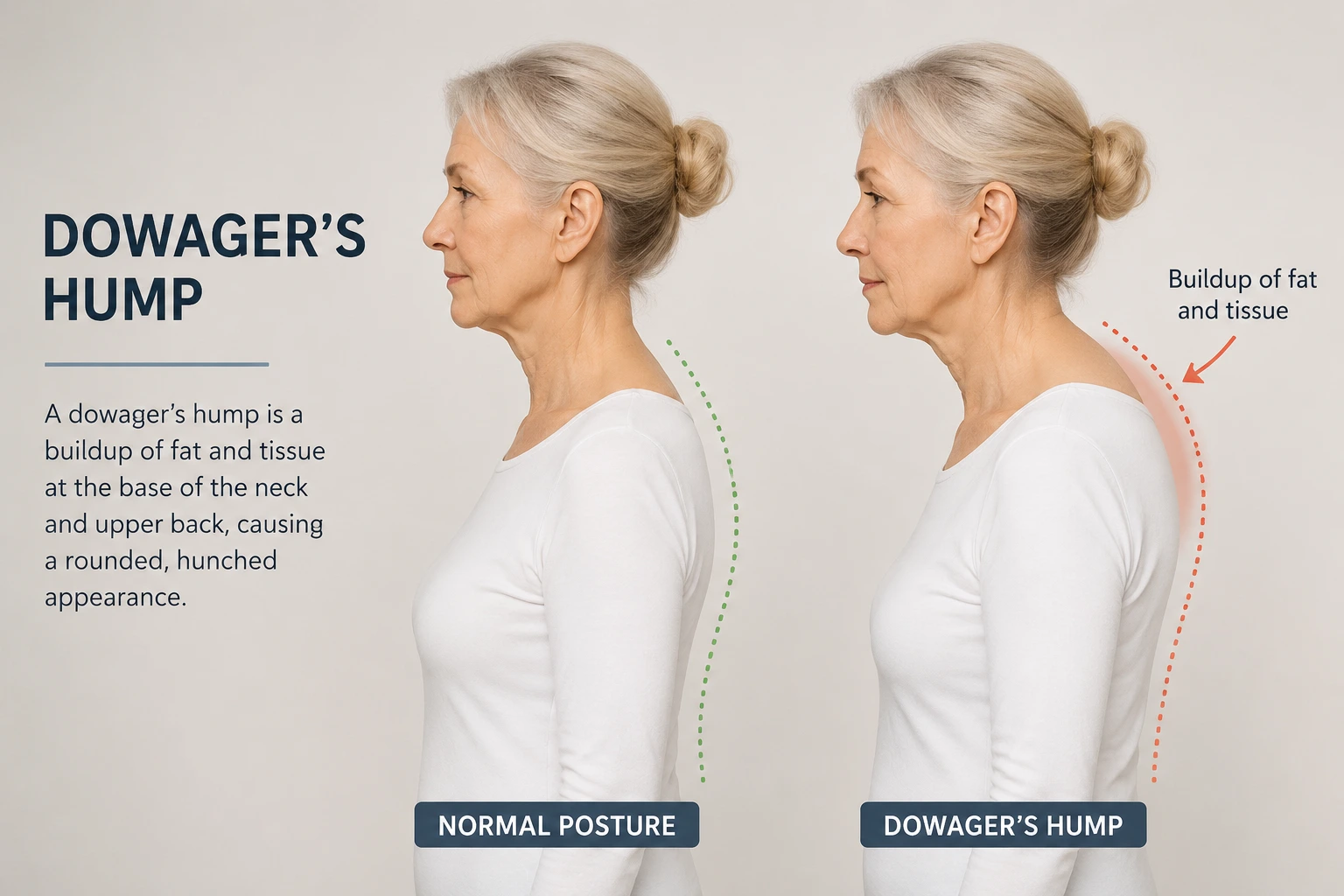
If you have noticed a rounded prominence at the base of your neck or between your shoulder blades, you are not alone. What many people dismiss as poor posture or simply getting older is often a condition with a specific structural cause — and one that, with the right approach, can be meaningfully addressed.
The condition is commonly known as a Dowager's Hump. Despite the name suggesting it only affects elderly women, it is increasingly common across all ages and is one of the most searched postural concerns in the UK. This blog explains what is actually happening in the spine when a Dowager's Hump develops, why it tends to get worse over time if left unaddressed, and what a thorough structural approach to correction actually involves.
What Is Actually Happening in the Spine
A Dowager's Hump is not simply a fat deposit or a cosmetic issue. At its core it is a structural problem, a change in the position and curvature of the cervical and upper thoracic spine that has developed over time.
The spine has natural curves. The neck curves gently forward, the upper back curves gently backward, and the lower back curves forward again. These curves distribute load across the spine efficiently and allow the head, which weighs approximately five kilograms, to sit balanced directly over the shoulders.
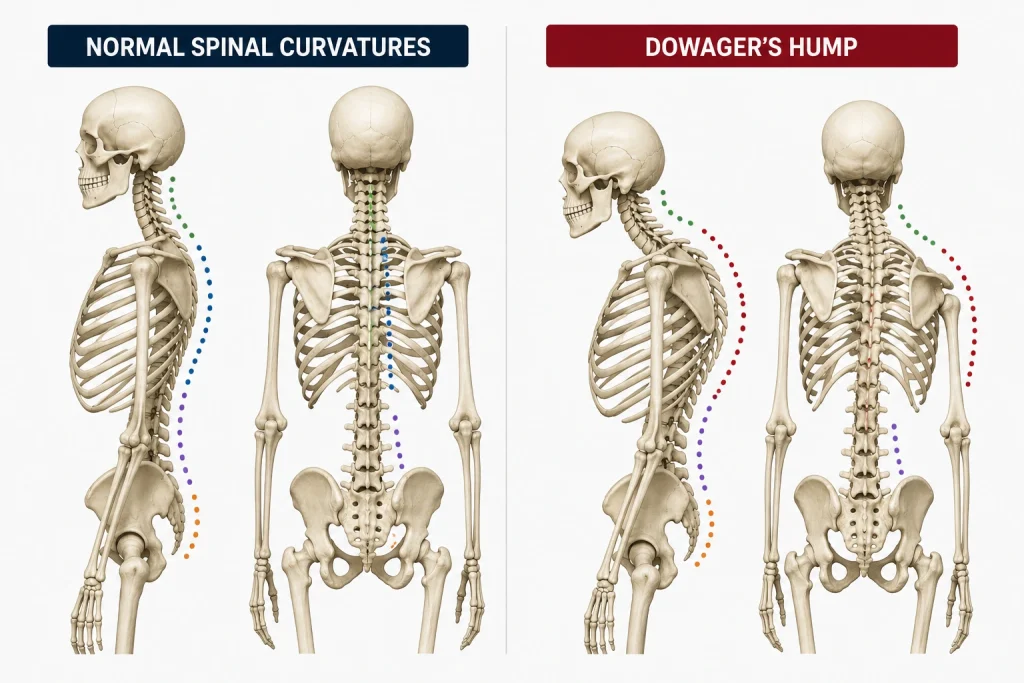
When the head begins to drift forward, which happens gradually through sustained poor posture, desk work, phone use, or unaddressed spinal restrictions, the mechanics of this system change dramatically. For every inch the head moves forward of its ideal position, the effective load on the cervical spine increases significantly. The muscles of the upper back and neck have to work harder to prevent the head from falling further forward. Over time they fatigue, tighten, and in doing so pull the upper thoracic spine into a more pronounced forward curve.
The body then begins to adapt to this new position. The soft tissues around the affected joints shorten and stiffen. The joints themselves begin to remodel. Fatty tissue may accumulate at the apex of the curve as a protective response. What started as a functional postural issue becomes an increasingly structural one.
This is why a Dowager's Hump tends to worsen rather than self-correct. The body adapts to the position it is most frequently held in, and once structural changes have occurred, they do not reverse themselves without specific intervention.
Why It Is Not Just an Older Person's Problem
The name Dowager's Hump carries an outdated association with elderly women and osteoporosis. While bone density loss can contribute to the condition in older adults, the drivers in younger people are quite different.
Prolonged sitting, sustained forward head posture during screen use, and poor ergonomic setups are now responsible for the early stages of this condition in people in their twenties and thirties. The spine does not need decades of poor posture to begin adapting. It simply needs sustained, repeated loading in the wrong position, and modern working life provides exactly that.
Children and teenagers are also increasingly affected, particularly those who spend significant time on phones and tablets. The structural changes that lead to a visible Dowager's Hump later in life often begin silently, years or even decades before anything is visible on the surface.
The Role of Spinal Misalignment
This is the piece that most advice on Dowager's Hump misses entirely.
Postural awareness, stretching, and ergonomic adjustments can slow the progression of the condition and reduce associated discomfort. But they cannot correct the underlying spinal misalignments that are often at the root of why the posture changed in the first place.
When individual vertebrae in the cervical or upper thoracic spine lose their correct position and motion, the muscles and soft tissues surrounding those joints adapt to compensate. The curve of the spine shifts to accommodate the restriction. Posture changes not because someone forgot to sit up straight, but because the underlying structure has changed in a way that makes good posture mechanically difficult to maintain.
Think of it as brickwork and wallpaper. You can paper over a misaligned wall, but the wall itself will not straighten. Postural advice is the wallpaper. The brickwork needs addressing too.
This is why two people can follow the same stretching programme and ergonomic advice and get very different results. The person with underlying spinal restrictions that have not been identified or corrected is working against their own structure. The person whose spine is moving and sitting correctly will find that good posture comes far more naturally.
Can a Dowager's Hump Be Reversed?
This is the question most people searching this topic want answered honestly. The answer is: it depends on how established the structural changes are, but in many cases significant improvement is possible.
In the early stages, before significant bony remodelling or degenerative change has occurred, the prognosis for meaningful structural improvement is good. The soft tissue adaptations can be reversed. The spinal curves can be improved. The head can be guided back toward a more balanced position over the spine. With consistent, specific correction over a course of care, visible and measurable change is achievable.
In more established cases, where degenerative change is present or where the condition has been developing for many years, the goal shifts toward slowing further progression, improving comfort and function, and restoring as much mobility and alignment as the structural changes allow. Meaningful improvement is still possible; the degree of change that can be achieved simply takes longer and requires realistic expectations.
What does not change regardless of how established the condition is: leaving it unaddressed means it will get worse. The forces driving the structural change do not stop simply because the condition has been accepted as normal.
What a Structural Assessment Reveals
At Northwood Chiropractic Oxford, we assess Dowager's Hump and forward head posture as structural problems rather than postural habits. This distinction changes the entire approach to care.
The Gonstead examination gives us a precise picture of what is happening in the spine. Postural analysis shows us how the head and shoulders sit relative to the pelvis. Instrumentation identifies areas of nerve irritation associated with restricted joints. Palpation locates the specific segments that have lost normal position and motion. Where indicated, standing X-rays allow us to measure the degree of forward head posture, the angle of the cervical and thoracic curves, disc health, and the exact vectors needed to begin correcting the problem.
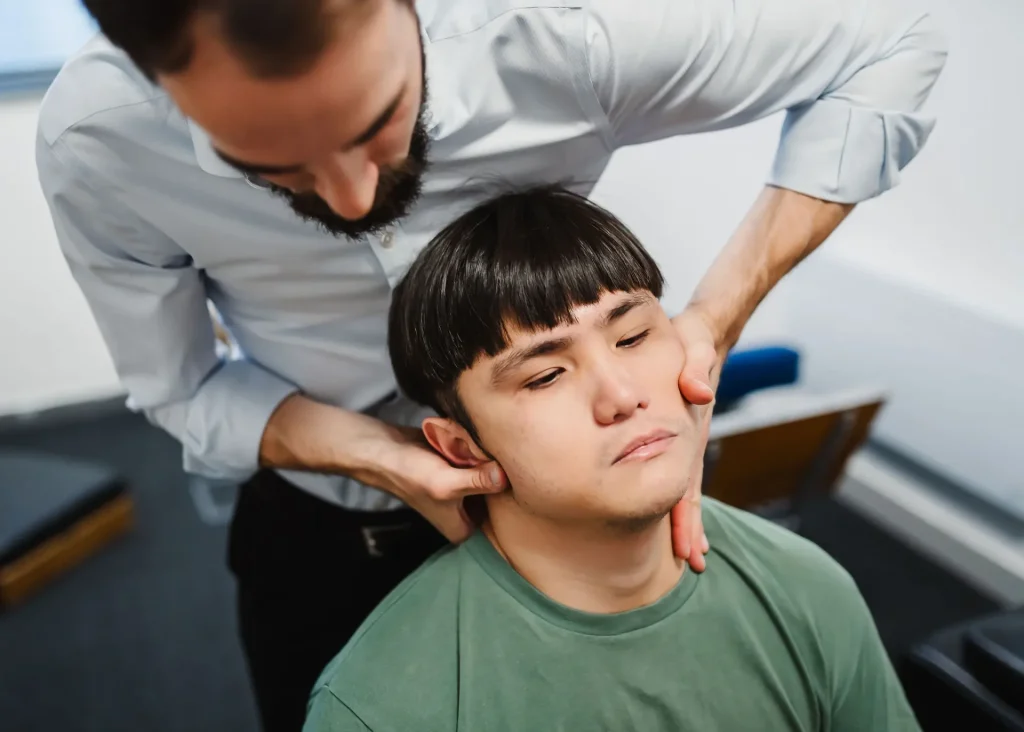
This level of detail matters. A Dowager's Hump is never just one thing. It involves a combination of cervical and thoracic segments, each contributing to the overall picture in a specific way. General advice cannot address specific misalignments. Specific misalignments require specific correction.
What You Can Do Alongside Chiropractic Care
Structural correction takes time and requires consistent professional input. But there are things that support the process and, done correctly, accelerate it.
Chin tucks are one of the most effective exercises for retraining the deep cervical flexors, the muscles that support the natural curve of the neck. Done properly, they draw the head back over the shoulders rather than simply tilting the chin down. Thoracic extension over a foam roller or the back of a chair helps restore movement to the stiff upper thoracic segments. Wall angels, performed with the back flat against a wall, retrain the scapular muscles and open the chest.
Ergonomic changes matter too. Raising the screen to eye level, supporting the lower back in a chair, and getting up to move regularly throughout the day all reduce the sustained loading that drives the condition forward. None of these changes will reverse established structural change on their own, but they are meaningful additions to a structured course of care.
Frequently Asked Questions
Is a Dowager's Hump permanent? Not necessarily. How much improvement is achievable depends on how long the condition has been developing and the extent of structural change present. Early intervention produces the best results, but meaningful improvement is possible even in established cases.
Does it cause pain? Not always, particularly in the early stages. Many people are unaware of the structural changes until the hump becomes visible. As the condition progresses, headaches, neck stiffness, upper back tension, and referred symptoms into the arms can develop.
How long does improvement take? This varies considerably based on the severity and duration of the condition. Functional improvements in posture and mobility can be seen relatively early in care. Structural changes take longer and require sustained, consistent correction.
Is it the same as kyphosis? They are related but not identical. Kyphosis refers to an exaggerated forward curve of the thoracic spine. A Dowager's Hump specifically refers to the prominence at the cervico-thoracic junction, often including a soft tissue component, and is typically associated with significant forward head posture.
Can it affect my breathing? Yes. Significant forward head posture and thoracic kyphosis can reduce chest expansion and affect breathing mechanics. This is one of the less well-known consequences of the condition and another reason to address it early.
The Bottom Line
A Dowager's Hump is not an inevitable part of ageing, and it is not simply a cosmetic concern. It is a structural problem with a structural cause, and it responds best to a structural solution. The earlier it is addressed, the more that can be done.
If you have noticed changes in your posture or have been told your head sits forward, an assessment is the right place to start. We can tell you exactly what is happening, how long it appears to have been developing, and what is needed to address it properly.
Book your initial consultation at Northwood Chiropractic Oxford.
👉 northwoodchiropracticoxford.co.uk/book-online
Published: 13th August 2026 Author: Dr Steven Hulme, Chiropractor, Northwood Chiropractic Oxford
