
The motivation to get back into exercise is a great thing. Whether it has been months or years since you were last active, the decision to start moving again is one of the best things you can do for your long-term health. But the enthusiasm that gets people off the sofa is often the same thing that puts them back on it with an injury two weeks later.
Getting back into exercise after a period of inactivity requires more care than most people realise. Understanding why, and what is actually happening in your body during those early weeks, makes it far easier to build a sustainable routine without getting derailed before you have even properly started.
What Happens to the Body During Inactivity
The body is an adaptation machine. It builds and maintains only what it needs, and when you stop loading it regularly, it gradually reduces its capacity to handle that load.
After a sustained period of inactivity, several things change. Muscle mass and strength decline. But muscles are only part of the picture, and arguably not the part that causes most problems when people return to exercise.
Tendons, ligaments, cartilage, and bones adapt to load far more slowly than muscles do. Muscle tissue responds relatively quickly to training stimulus, often showing strength gains within a few weeks. The connective tissue that supports those muscles, the tendons that anchor them to bone, the ligaments that stabilise the joints, the cartilage that cushions the surfaces, these structures adapt on a much longer timescale. They have a poorer blood supply, which means they receive nutrients and respond to training stimulus more slowly.
This creates a dangerous mismatch when returning to exercise. Your muscles may feel capable of handling a given load well before the surrounding connective tissue has adapted to support it. You feel strong enough to push harder. The tendons and ligaments are not ready. And that gap is precisely where injuries occur.
The Risk of Doing Too Much Too Soon
The most common mistake people make when returning to exercise is underestimating how much their capacity has declined, and overestimating how quickly it will return.
A run that felt manageable eighteen months ago will not feel the same today. A weight session at your old working weights will place entirely different demands on a body that has been largely sedentary in the interim. The temptation to pick up where you left off, or to push hard in those first sessions because motivation is high, is understandable. But the consequences are predictable.
Tendons subjected to sudden high loads without adequate progressive preparation can become inflamed and painful, a condition known as tendinopathy. Ligaments placed under unexpected stress can strain. Joints that have not been loaded through their full range regularly can respond poorly to being asked to do so all at once. Muscles that have lost coordination with surrounding stabilising structures can be pulled or torn.
What makes this particularly frustrating is the timing. Many of these injuries do not show up in the first session, or even the first week. Connective tissue injuries in particular often develop gradually, with pain appearing days or weeks after the loading that caused them. By the time you feel it, the damage is already done.

You Are Training More Than Just Your Muscles
This is a shift in perspective that makes a significant difference to how you approach returning to exercise.
When you train, you are not just building muscle. You are conditioning an entire system of structures, many of which take considerably longer to adapt than muscle tissue. Tendons need to become stiffer and stronger to transfer force efficiently. Ligaments need to develop the tensile strength to stabilise joints under increasing load. Cartilage needs progressive loading to maintain its integrity. Bones respond to mechanical stress by increasing their density and strength over time.
All of this happens, but it happens slowly. The research suggests that while muscles can show meaningful adaptation in four to eight weeks, tendons and ligaments may take months to reach equivalent adaptation. Bone remodelling in response to new loading demands can take even longer.
This does not mean progress is slow in any discouraging sense. It means that the early weeks of returning to exercise are an investment in the foundation that all future training is built upon. Respect that process, and the structure you build will support you for years. Rush it, and the structure gives way before it is ready.
How to Build Back Gradually
The principle is simple: progressive overload, applied conservatively in the early stages. Here is what that looks like in practice.
Start well within your perceived capacity. If you feel you could run for twenty minutes comfortably, run for ten. If you think you could lift a particular weight for twelve reps, do eight. The goal in the first two to four weeks is not to test your limits. It is to begin the adaptation process at a level the whole system, including connective tissue, can handle.
Increase load gradually and systematically. A commonly cited guideline is to increase training volume or intensity by no more than ten percent per week. This applies to running distance, weight lifted, number of sessions, or any other measure of load. It feels conservative when motivation is high. It is the reason people stay healthy while those around them get injured.
Prioritise consistency over intensity. Three moderate sessions per week for two months will build a better foundation than two weeks of hard training followed by an injury and three weeks off. The body adapts to consistent, repeated stimulus over time. Consistency is the variable that matters most in the early stages.
Allow adequate recovery between sessions. Adaptation does not happen during exercise. It happens during recovery. In the early weeks of returning to training, leaving at least one full rest day between sessions allows the body to complete the repair and adaptation process before being loaded again.
Listen to discomfort carefully. There is a difference between the normal muscle fatigue and mild soreness of returning to exercise, and the sharp, localised, or persistent pain that signals something is being damaged. The former is expected and manageable. The latter is a signal to stop, rest, and if it does not resolve quickly, to get it assessed.
How Chiropractic Supports a Safe Return to Exercise
Starting exercise again places new and increasing demands on the spine, pelvis, and the entire musculoskeletal system. How well your body handles those demands depends significantly on how well it is functioning before and during the process.
This is where Chiropractic care plays a meaningful supporting role.
When spinal joints are restricted or misaligned, the nervous system is not communicating as efficiently as it should. Muscle coordination is subtly disrupted. Proprioception, the body's ability to sense its own position and movement in space, is reduced. The deep stabilising muscles of the spine and core, which are essential for safe, efficient movement under load, may not be activating as they should.
These are not dramatic deficits. You would not necessarily be aware of them. But under the increasing demands of a return to exercise, they matter. A body that is not moving and coordinating efficiently is more likely to load joints and connective tissue unevenly, creating the kind of asymmetrical stress that accumulates into injury over time.
Chiropractic Adjustments restore normal position and motion to restricted spinal joints, which improves nervous system function and allows the muscles supporting the spine and the rest of the body to work as they were designed to. The result is better movement quality, more efficient load transfer, and a nervous system that is better equipped to coordinate the demands of exercise.
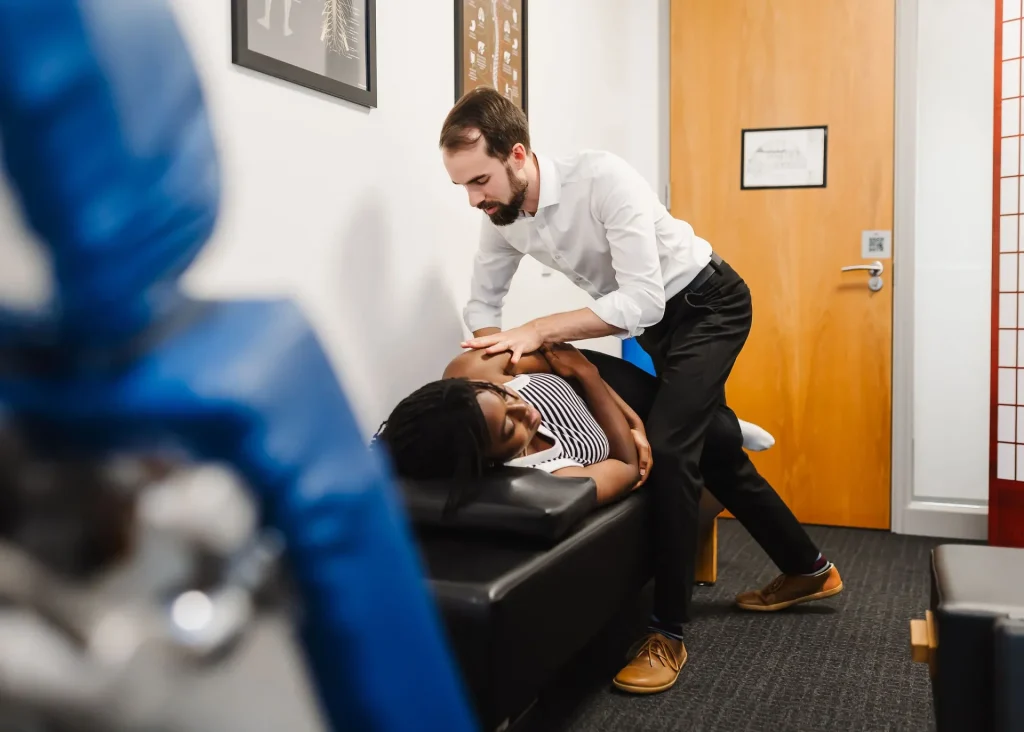
Regular Chiropractic care during a return to exercise does not replace gradual progression or sensible training habits. But it creates the best possible mechanical and neurological environment for the body to adapt, perform, and stay healthy throughout the process.
If you are returning to exercise after a significant period of inactivity, a spinal assessment before you begin, or early in the process, is a worthwhile step. Identifying and addressing any restrictions before you start placing new demands on the body means you are building on a solid foundation from the outset.
Frequently Asked Questions
How long should I wait before returning to exercise after a long break? There is no universal waiting period. The key is not how long you wait but how you approach the return. Start conservatively, progress gradually, and pay attention to how your body responds in the days following each session.
Is it normal to feel sore when starting exercise again? Yes. Delayed onset muscle soreness in the days following unaccustomed exercise is entirely normal and is a sign the muscles are adapting. It typically peaks around 24 to 48 hours after exercise and resolves within a few days. Sharp, joint-specific, or persistent pain is different and warrants attention.
Should I stretch before exercising? Current evidence favours a dynamic warm-up over static stretching before exercise. Gentle movement that increases blood flow and takes joints progressively through their range is more effective preparation than holding static stretches cold.
Can Chiropractic care help with an existing exercise injury? Yes. Many common exercise injuries, including those affecting the lower back, hips, knees, and shoulders, have a spinal and neurological component that Chiropractic care addresses well. A thorough assessment will identify what is driving the injury rather than simply treating the painful area.
How often should I see a Chiropractor when returning to exercise? This depends on your individual findings and goals. Some patients benefit from care at the start of a new training block to optimise function; others use it reactively when issues arise. We advise on frequency based on what your examination reveals.
The Bottom Line
Returning to exercise is one of the best decisions you can make for your health. Doing it well, with patience and an understanding of what your body needs in those early weeks, is what determines whether it becomes a lasting habit or a short-lived attempt ended by injury.
Start well within your capacity, build gradually, give your connective tissue the time it needs to adapt, and make sure your body is functioning as well as it can throughout the process.
Book your initial consultation at Northwood Chiropractic Oxford today.
👉 northwoodchiropracticoxford.co.uk/book-online
Published: 5th August 2026 Author: Dr Steven Hulme, Chiropractor, Northwood Chiropractic Oxford
