
If you spend most of your working day at a desk and your back is suffering for it, you are not alone. Back pain related to prolonged sitting is one of the most common complaints we see at Northwood Chiropractic Oxford, and in most cases it is entirely preventable. Understanding why sitting causes problems in the first place is the first step toward doing something meaningful about it.
Why Sitting Causes Back Pain
Sitting might feel like rest, but for your spine it is anything but.

Research consistently shows that sitting creates more pressure through the spinal discs than almost any other position, including standing. When you sit, particularly in a slumped or forward-leaning position, the load on the lumbar discs increases significantly. Over hours, days, and years, that sustained pressure takes its toll.
There is a second problem that is equally important: joints are designed to move. When spinal joints stop moving, the surrounding tissues stiffen, the muscles supporting the spine fatigue and tighten, and the joints themselves become irritated. The spine is not built for sustained static loading. It thrives on movement, and modern working life gives it very little.
The pain that builds through a long day at a desk is not simply muscular tiredness. It is the spine telling you that it has been held in the same position for too long, under more load than it was designed to sustain.
Getting Your Desk Setup Right
While movement matters more than any desk setup (more on that shortly), the position you sit in does make a difference, particularly if you are going to be in that position for extended periods. A few simple adjustments can take a significant amount of unnecessary stress off the spine.
Screen Height
Your monitor should sit at eye level so that your head is balanced directly over your shoulders. A screen that is too low causes the head to drop forward, and for every inch the head moves forward the effective load on the cervical spine increases dramatically. Over a full working day, this adds up to an enormous amount of cumulative stress on the neck and upper back. If you are using a laptop, a separate screen or a laptop stand with an external keyboard is one of the most worthwhile investments you can make for your spinal health.
Chair Height and Lumbar Support
Your chair height matters more than most people realise. Ideally, your hips should sit slightly higher than your knees, so that your thighs angle gently downward toward the floor. This small adjustment reduces the angle at the hip and takes pressure off the lumbar spine by encouraging a more natural lower back curve. A chair that is too low does the opposite, forcing the hips into a deep flex that flattens the lumbar curve and increases disc pressure.
Good lumbar support helps maintain the natural inward curve of the lower back. Without it, the lower back tends to round, shifting load onto the posterior discs and the surrounding ligaments. If your chair does not offer adequate support, a rolled towel or small cushion placed at the small of the back can make a meaningful difference.
Screen Distance
Your monitor should sit roughly an arm's length away. Too close and you find yourself leaning forward; too far and you strain to read, tipping the head forward in the process. Both pull the spine out of its natural alignment over time.
Watch the video below to see exactly what this looks like.
Movement Matters More Than Posture
Here is the most important point in this entire article: no desk setup, however well optimised, is a substitute for regular movement.
The research on this is clear. The problem with sitting is not just how you sit. It is how long you sit without moving. Even a perfectly set up workstation causes problems if you remain static in it for hours on end. The spine needs to move regularly to maintain healthy disc nutrition, joint mobility, and muscle function.
A practical target is to get up and move for a few minutes every thirty to forty-five minutes. It does not need to be a workout. A short walk to make a drink, a few minutes standing, some gentle movement through the spine. What matters is breaking the static loading pattern regularly throughout the day.
If you struggle to remember to move, set a timer. It sounds simple because it is, but the impact on spinal health over months and years is substantial.
The Case for a Standing Desk
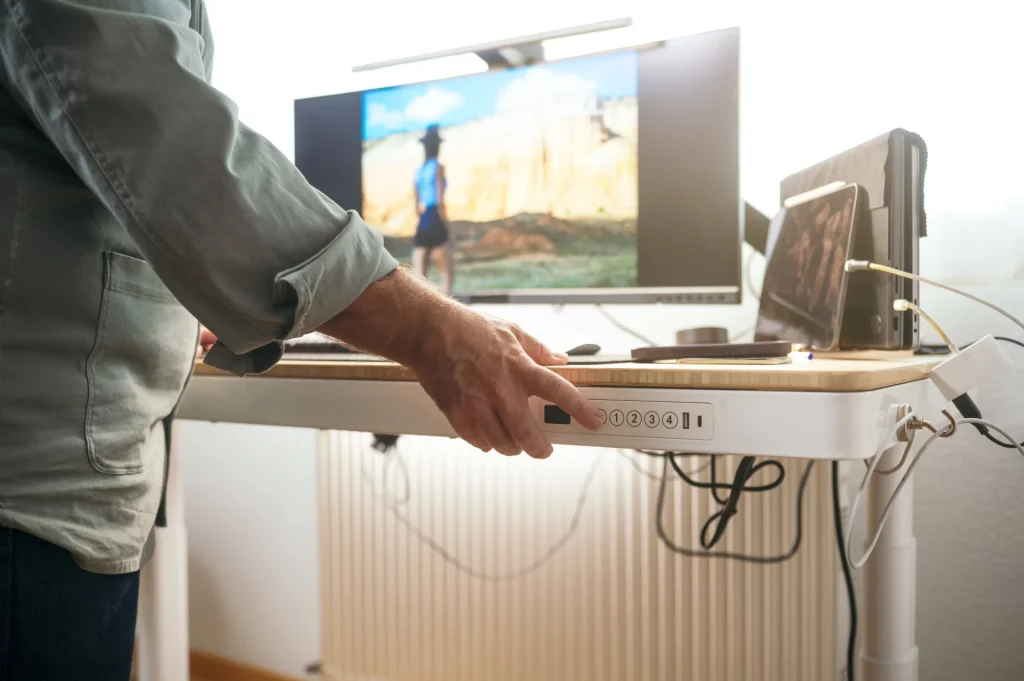
Standing desks have become increasingly popular, and for good reason. The benefit is not simply that standing is better than sitting. It is that a standing desk gives you the ability to change position constantly throughout the day, alternating between sitting and standing as you work.
This variety of position is what the spine craves. No single position, including standing, is ideal for sustained periods. But the ability to shift between positions, to adjust and move and change your loading pattern regularly, is enormously beneficial compared to being locked into one posture for eight hours.
If a standing desk is not an option, a height-adjustable monitor arm or a simple desk riser can offer some of the same benefit by giving you more flexibility in how you work across the day.
Drink More Water Than You Think You Need
This is one of the most underestimated factors in spinal health, and it is one of the easiest to address.
Your intervertebral discs, the shock-absorbing structures between each vertebra, are largely made of water. Throughout the day, as they are compressed under the load of sitting, they lose fluid. At night, when you are lying down and the pressure is relieved, they rehydrate. This is why you are measurably taller first thing in the morning than you are by the end of the day.
When you are dehydrated, the discs cannot rehydrate as effectively. Over time, chronically under-hydrated discs become thinner, less resilient, and more vulnerable to the kind of wear and degenerative change that causes lasting problems. Staying well hydrated throughout the day is a simple, cost-free way to support the long-term health of your discs and spine.
Aim for at least two litres of water per day, more if you are active or in warm conditions. It will not fix a structural problem, but it will give your spine the best possible environment to stay healthy.
When Self-Help Is Not Enough
The steps above will help most people reduce the impact of prolonged sitting on their spine. But if you are already experiencing persistent back pain, stiffness, or referred symptoms into the legs, it is worth finding out whether there is an underlying structural issue that needs addressing.
Back pain from sitting is often the final straw rather than the original problem. The spine may have been building toward this point for some time, and the hours at a desk are simply the thing that pushed it over the edge. In that case, adjusting your desk setup and drinking more water will help at the margins, but they will not resolve the underlying cause.
A thorough spinal assessment gives us a clear picture of what is actually happening in your spine, how long it has been building, and what is needed to address it properly.
Frequently Asked Questions
Is sitting really worse than standing for your back? In terms of disc pressure, yes. Sitting, particularly with poor posture, generates more load through the lumbar discs than standing. However, sustained standing without movement also causes problems. The key is variety and regular movement throughout the day, not simply swapping one static position for another.
How long is too long to sit without moving? Most spinal health guidelines suggest moving for a few minutes at least every thirty to forty-five minutes. Even brief movement is enough to restore circulation, reduce disc pressure, and prevent the joints from stiffening.
Can a standing desk cure back pain? Not on its own. A standing desk is a useful tool for increasing positional variety throughout the day, but it is not a treatment for structural spinal problems. If your back pain is persistent, an assessment is the appropriate first step.
Should I use a lumbar roll or back support? For most people, yes. Maintaining the natural lumbar curve while sitting reduces disc pressure and takes stress off the surrounding ligaments and muscles. A purpose-made lumbar roll or even a rolled towel placed at the small of the back is a simple and effective way to do this.
When should I see a Chiropractor about back pain from sitting? If your back pain is persistent, recurring, or accompanied by symptoms into the legs such as sciatica, it is worth getting assessed. Do not wait until it becomes severe. The sooner the underlying cause is identified, the easier it is to address.
The Bottom Line
Sitting is unavoidable for most people. But the impact it has on your spine is not. Regular movement, a sensible desk setup, and good hydration are all within your control and all make a real difference. If the pain is already established, finding out what is driving it is the most important next step.
Book your initial consultation at Northwood Chiropractic Oxford today.
👉 northwoodchiropracticoxford.co.uk/book-online
Published: 29sth July 2026 Author: Dr Steven Hulme, Chiropractor, Northwood Chiropractic Oxford
