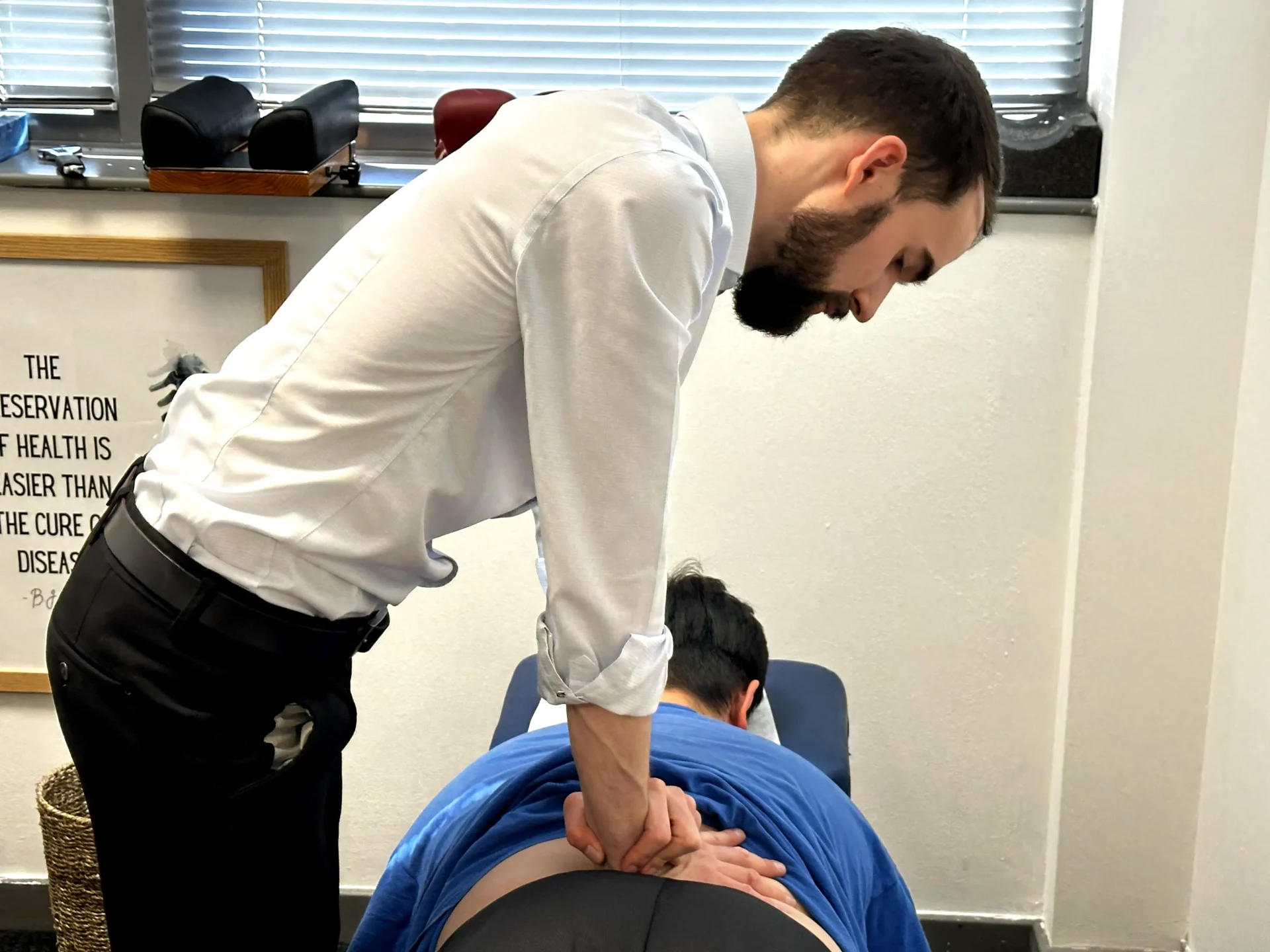
If you have ever wondered what a Chiropractor actually does beyond "clicking backs," you are not alone. It is one of the most Googled questions in healthcare, and the answer is far more interesting than most people expect. This guide breaks down what Chiropractic care really involves, how the Gonstead method takes it to another level, and why the brain-body connection sits at the heart of everything we do at Northwood Chiropractic Oxford.
What Is a Chiropractor?
A Chiropractor is someone who specialises in finding and correcting what we call misalignments in the spine (restricted joints that are not in their normal position) to improve the communication between the brain and body and help the body function better, reduce pain and ultimately allow people to do more in life!
But the spine is not simply a stack of bones. It is the primary highway of your nervous system, housing the spinal cord and giving exit points to the nerves that control and coordinate virtually every function in your body. This is why Chiropractic care is about much more than back pain.

What Conditions Do Chiropractors Treat?
Chiropractors are commonly associated with back and neck pain, but the scope of conditions they help with is broad:
- Lower back pain and sciatica
- Neck pain and stiffness
- Headaches and migraines
- Shoulder pain and frozen shoulder
- Hip and joint pain
- Dizziness and BPPV (benign paroxysmal positional vertigo)
- Tennis elbow and carpal tunnel syndrome
- Postural problems
- Sports injuries and recovery
The common thread across all of these is the nervous system. When the spine is not moving and sitting correctly, it can place mechanical stress on the nerves that supply the surrounding and distant tissues. Restore the movement and position of the spine, and you restore the communication between brain and body.
Does a Chiropractor Just "Crack" Your Back?
This is probably the most common misconception. The audible sound sometimes heard during a Chiropractic Adjustment is called a cavitation. It is the release of gas from within the joint as pressure changes, similar to knuckle cracking. It is entirely normal, not harmful, and not actually the goal of the Adjustment itself.
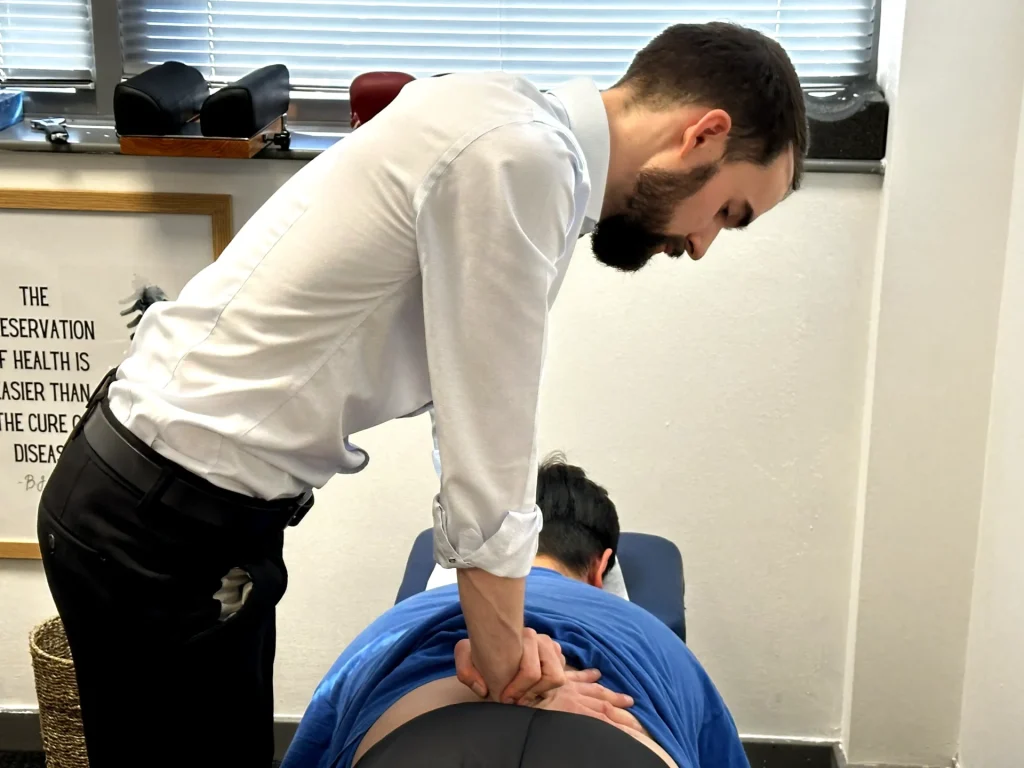
The Adjustment, done correctly, is a precise, controlled movement applied to a specific joint to restore its normal position and motion. The sound is incidental. What matters is the accuracy and specificity of where, how, and why the Adjustment is delivered.
The Brain and Body Connection
To understand why Chiropractic works, you first need to understand the relationship between your spine and your nervous system.
Your brain communicates with every organ, muscle, gland, and tissue in your body through your spinal cord and the nerves that branch out from it. This is not a one-way system. Signals travel both up to the brain and down from it continuously, moment to moment, regulating everything from pain signals and muscle tone to digestion, immune function, and healing.
When a spinal joint loses its normal position or movement, something called a misalignment occurs. A misalignment is not simply a joint "out of place" in a dramatic sense. It is a subtle distortion in the position and motion of a vertebra that creates mechanical irritation to the surrounding nerves and disrupts the normal flow of information between brain and body.
Think of it like a dimmer switch on a light. The connection is still there, but the signal is reduced or distorted. Over time, this altered communication has consequences, not just locally in the spine, but in the areas of the body those nerves serve.
A Chiropractic Adjustment restores the correct position and motion to the affected joint, removing the mechanical irritation and allowing the nervous system to communicate clearly once more. This is why people often report improvements not just in their pain, but in sleep, energy, digestion, and overall wellbeing following Chiropractic care. The body functions better when the nervous system functions better.
What Is Gonstead Chiropractic?
Gonstead Chiropractic is widely considered the gold standard within the Chiropractic profession. Developed by Dr. Clarence S. Gonstead in the mid-20th century, it is a highly specific, thorough, and evidence-based system of analysis and correction that sets itself apart from general Chiropractic in a number of important ways.
Where general Chiropractic may rely primarily on symptom location or surface-level motion testing, the Gonstead method uses five specific criteria to identify exactly where the problem is, what type of misalignment is present, and the precise direction of correction required:
1. Visualisation — The Chiropractor observes posture, symmetry, gait, and any visible signs of compensation or distortion in how you hold and move your body.
2. Instrumentation — A neurocalometer (or nervoscope) is used to scan the spine and detect differences in skin temperature on either side of the vertebral column. These temperature differentials indicate areas of nerve irritation and inflammation, and they do not lie.
3. Static Palpation — The Chiropractor feels the spine at rest to identify areas of swelling, muscle tension, and changes in tissue texture that indicate a misalignment.
4. Motion Palpation — Each spinal segment is assessed for how it moves in all directions, identifying joints that are restricted or moving abnormally.
5. X-ray Analysis — Full-spine X-rays, taken in a standing weight-bearing position, allow precise measurement of spinal alignment, disc health, and the exact vectors needed to correct each subluxation. Gonstead X-ray analysis is extraordinarily detailed, measuring angles, disc heights, and vertebral positions to fractions of a degree.
Only once all five criteria have been assessed does a Gonstead Chiropractor make a clinical decision about where to adjust, and crucially, where not to.

The Sniper, Not the Shotgun
This is one of the most important distinctions to understand about Gonstead Chiropractic, and it is something we take seriously at Northwood Chiropractic Oxford.
Many approaches to spinal care operate like a shotgun. Adjust everything. Mobilise widely. Use broad techniques across multiple segments in the hope that something helps. It can feel good in the moment, but it lacks precision, and precision is everything when you are working with the nervous system.
The Gonstead method operates like a sniper. Every Adjustment is deliberate, targeted, and justified by the analysis. We do not adjust a joint unless the full five-criteria assessment tells us it needs it. We do not guess. We do not treat the area of pain and assume that is the source. We follow the evidence the body gives us, identify the specific level causing the problem, and correct it with the exact force, direction, and speed required.
This matters for two reasons. First, unnecessary Adjustments to segments that are already hypermobile can cause harm. Second, adjusting the wrong level does not fix the actual problem, which means patients spend more time in care with less improvement.
Specificity is not just a preference at Northwood Chiropractic Oxford. It is the principle that underpins everything we do.
What Happens at Your First Chiropractic Appointment?
At your first visit, we carry out a thorough consultation and examination before any care takes place. This includes:
- A detailed case history covering your current concern, health background, lifestyle, and goals
- Postural and neurological assessment
- Full Gonstead five-criteria spinal analysis
- X-rays where clinically indicated
- A clear explanation of our findings and a recommended care plan
Nothing is done without your understanding and consent. If we find something outside our scope, we refer you to the appropriate specialist. If we find that Chiropractic is the right fit for you, we will tell you exactly what we found, what it means, and what we can do about it.

Is Chiropractic Safe?
Yes. When performed by a qualified and registered Chiropractor, Chiropractic care has an excellent safety record. All UK Chiropractors are regulated by the General Chiropractic Council (GCC), which sets and enforces standards of education, conduct, and practice.
Serious adverse events from Chiropractic Adjustments are extremely rare. Some patients experience mild soreness in the adjusted area for a day or two following their first Adjustment, similar to how muscles feel after exercise. This is normal and typically short-lived.
The Gonstead method's emphasis on precise analysis before any Adjustment further reduces risk, because no joint is moved without clinical justification for doing so.
How Is Chiropractic Different from Physiotherapy or Osteopathy?
This is a common question, and the distinctions matter.
Physiotherapy focuses primarily on rehabilitation, exercise prescription, and soft tissue work. It is an excellent profession for post-surgical recovery and movement retraining, but it does not specifically address spinal alignment or the neurological consequences of vertebral misalignment.
Osteopathy shares some philosophical roots with Chiropractic and uses manual techniques, but tends toward broader, more general mobilisation rather than specific spinal correction. The five-criteria Gonstead analysis, in particular, is unique to Chiropractic.
Chiropractic, and specifically the Gonstead method, is focused on identifying and correcting subluxations with the precision required to restore nervous system function. The emphasis on neurological assessment, X-ray analysis, and specific segmental correction is what distinguishes it.
None of these professions is superior in every situation. But for specific spinal and neurological complaints where precision matters, Gonstead Chiropractic is unmatched.
Frequently Asked Questions
How many sessions will I need? This depends entirely on your case, how long the problem has been present, your age, lifestyle, and how your body responds. We provide a clear care plan after your initial examination so you know exactly what to expect.
Do I need a GP referral to see a Chiropractor? No. You can book directly with us. Chiropractors are primary contact practitioners, meaning you do not need to see your GP first.
Will Chiropractic help my headaches? Many headaches, particularly tension-type and cervicogenic headaches (those originating from the neck), respond very well to Chiropractic care. Migraine frequency can also reduce with spinal correction when the cervical spine is contributing to the trigger. We assess each case individually.
Is Chiropractic just for back pain? No. While back and neck pain are the most common reasons people initially seek care, the reach of the nervous system means that Chiropractic can have a positive impact on a wide range of conditions. Many patients report improvements in sleep, energy, digestion, and general health as their nervous system function improves.
Does it hurt? Most people find Chiropractic Adjustments comfortable, and many describe an immediate sense of relief. Some experience mild soreness afterwards, especially after the first few visits as the body begins to adapt to the corrections.
Ready to Find Out What Is Really Going On?
If you have been living with pain, stiffness, headaches, or any of the conditions described above, and you want answers rather than guesswork, we are here to help.
At Northwood Chiropractic Oxford, we combine over a decade of Gonstead specialist experience with thorough, evidence-based analysis to get to the root cause of your problem, not just manage the symptoms.
Book your initial consultation today and take the first step toward understanding what your spine and nervous system are really trying to tell you.
Published: 17th June 2026
Dr Steven Hulme (Doctor of Chiropractic)
